

Featured Apprentice
Matthew Taylor
“Don't let rejection stop you. Learn something from each one, improve and go into the next application stronger than you were before.”
Before the Apprenticeship
Before starting my apprenticeship, I took a gap year after finishing my A-levels in Further Maths, Maths and Physics. By Year 13, I already knew that I wanted to pursue a degree apprenticeship in data analytics, so I used my gap year to develop skills that would help prepare me for that career. I completed an Excel course, did Python learning and spent time developing my skills in podcast and music production. Alongside this, I worked part-time as a labourer for a kitchen and bathroom fitting company, which gave me experience of working in a very different environment and earning while preparing for my apprenticeship.
Challenges & Barriers
One of the biggest challenges was how competitive degree apprenticeships are. I applied for many different data analytics apprenticeships and went through lots of application stages, interviews and assessment centres. During Year 13, I also found it difficult balancing applications with A-level revision, as each application could require a lot of preparation, particularly for interviews and assessment centres. I originally wanted to start a degree apprenticeship straight after my A-levels, but I wasn't able to secure one that year. Rather than defaulting to the traditional university route, I decided to take a gap year, improve my skills and apply again. One of the hardest parts was staying motivated after rejections. Each new application meant starting the process again: researching another company, tailoring my application and preparing for different questions and interviews. It could be frustrating, but I was determined that a degree apprenticeship was the route I wanted to take, so I kept applying.
“The main motivation for me was the advantages a degree apprenticeship offered compared with the traditional university r...”
The main motivation for me was the advantages a degree apprenticeship offered compared with the traditional university route. I could earn a full-time salary while gaining hands-on experience, building a professional network and working with the latest technology and tools, all while studying towards a degree. I also liked the applied style of learning, where I could take what I was learning and use it in a real working environment. I've always been determined to make the most of the opportunities I have, and I saw a degree apprenticeship as a way to accelerate my development and get a strong start to my career. My faith also played an important part in the decision. As a Christian, I prayed a lot about what direction to take with my career, and I felt that God was leading me towards the degree apprenticeship route. That gave me confidence to stick with it, even when I wasn't successful in securing one the first time around. I knew I'd get the right one for me.
How I Found My Apprenticeship
I found my apprenticeship through LinkedIn. While I was doing my A-levels, my older sibling encouraged me to create a LinkedIn account and add my experience, skills and interests. One day, a degree apprentice at Oliver Wyman reached out to me, initially thinking I was already a degree apprentice myself and looking to network. Although I wasn't an apprentice at the time, we stayed in touch and he told me about the programme he was part of at Oliver Wyman. I was really interested in the opportunity, so when applications eventually opened, I applied. I went through the application process, was offered a place, and the rest is history.
The Turning Point
The turning point for me was the assessment centre at Oliver Wyman. I wasn't completely sure what to expect, so I just turned up, tried to be myself and did the best I could. What stood out most, though, was how much I genuinely enjoyed the day. Everyone I met was friendly and collaborative, and it gave me a real sense that Oliver Wyman would be a great environment to work in. Even the interview felt different from others I had experienced. Rather than feeling like a checklist of questions, it felt much more like a genuine conversation, which allowed me to relax and enjoy it. From that day onwards, I was certain that Oliver Wyman was where I wanted to work.
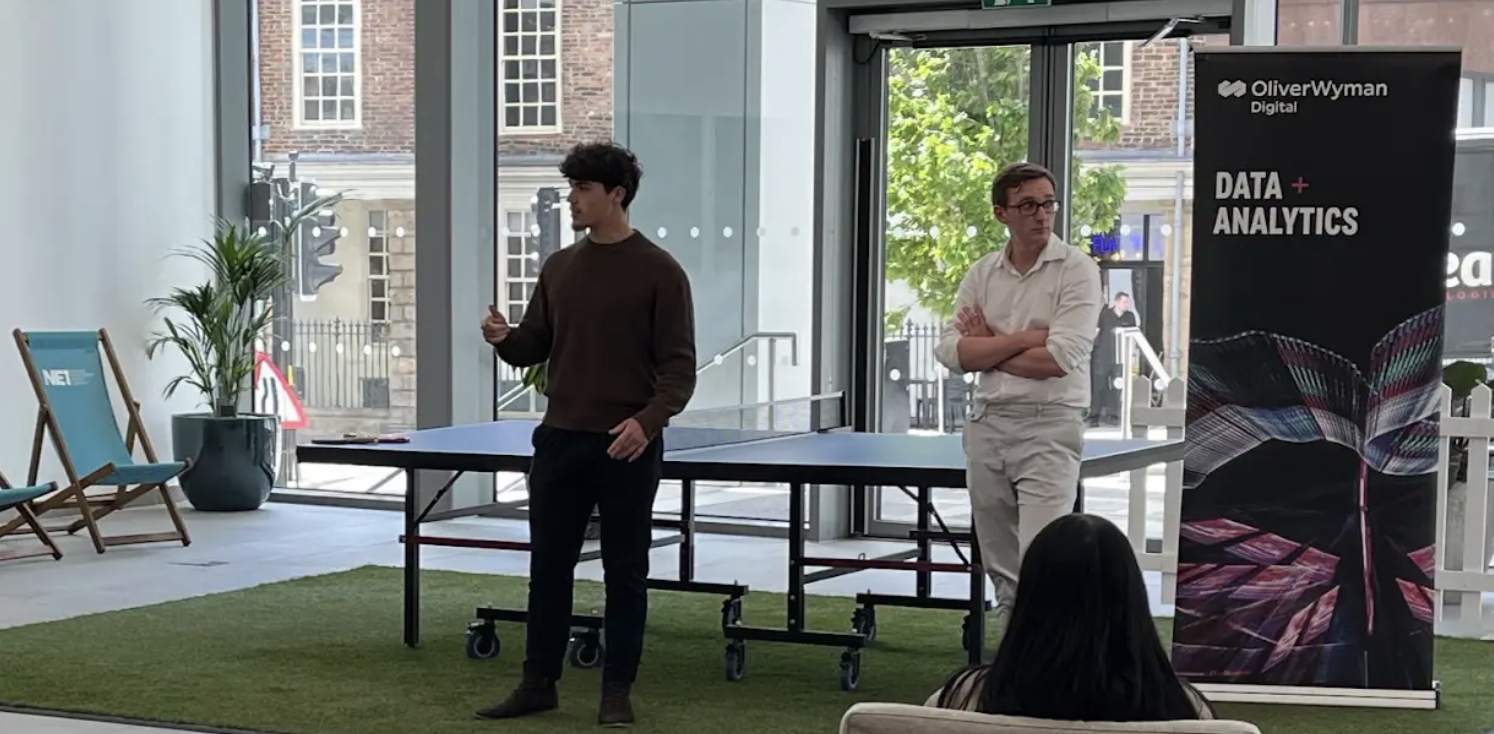
Matthew Taylor on the job — Oliver Wyman
Photo Gallery

My Current Role
A typical day starts at around 8:30am. I'll get into the office, set up my workspace and catch up with colleagues before usually having a morning stand-up with my manager and team to align on priorities and tasks for the day. From there, I'll work through my tasks while staying in regular contact with the team to share progress, ask questions and address any issues. At lunch, I'll normally head out with colleagues to grab some food before coming back to eat together. I usually finish the day by sending my manager an end-of-day update before leaving at around 4:30pm. As I work in consulting, I rotate onto different projects roughly every six months. This gives me exposure to different industries, teams and types of work, with each project requiring different skills, software and ways of working. That variety has meant I've learned a huge amount in a relatively short space of time. I've developed my Python and SQL skills significantly, learned more about business processes and different industries, and gained experience using AI and integrating it into our work. I've also learned a lot that isn't purely technical, such as how to work effectively within a team and adapt my communication style depending on the person or stakeholder I'm speaking to. And, of course, I've learned plenty of business jargon along the way!
Impact on My Life
My apprenticeship has had a massive impact on me, both personally and professionally. One of the biggest changes has been my confidence. Working with lots of different people, from different backgrounds and with different personalities, has made me much more comfortable communicating with others. I've learned how to build professional relationships, work as part of a team and adapt the way I communicate depending on who I'm speaking to. It's also given me a lot more independence at a young age. Earning a full-time salary has allowed me to start saving, buy my first car and have more freedom to invest in things that are important to me, whether that's eating well, going to the gym or pursuing my interests outside of work. Having that financial independence while still working towards a degree is something I really value. Professionally, I've developed far more than just technical skills. Being exposed to different projects, problems and people has changed the way I think and approach challenges. I've become more confident figuring things out for myself and applying what I've learned in new ways. For example, the coding and problem-solving skills I've developed at work have helped me start building my own apps outside of work to solve problems in my own life. Probably the biggest overall impact is the sense of momentum it has given me. I have a career that I can continually develop in, while also studying towards my degree and learning outside of work. There is always another skill to improve or something new to learn, which keeps me motivated to keep progressing and see how far I can take my career.
My biggest achievement so far has probably been developing a set of AI skills to help the consultant side of my team speed up some of the slower, more manual processes on our project. It was really rewarding to build something that had a practical impact on the team and could save people a significant amount of time. I received some great feedback from the consultants who used the skills, which gave me confidence that what I had built was genuinely useful rather than just technically interesting. I then had the opportunity to present the work more widely across Oliver Wyman, with over 100 people joining the Teams session. Presenting something I had created to that many people was quite a big moment for me, especially as an apprentice, and it made me proud to see work I had developed on my project gaining interest beyond my immediate team.
Advice to Aspiring Apprentices
“I would 100% recommend an apprenticeship to someone who wants to get a head start in their career and likes the idea of learning through real experience. My biggest advice would be to start early and be proactive. Research the companies you would genuinely like to work for, connect with current apprentices on LinkedIn and ask them about their experiences. Find ways to develop relevant skills before you apply, and be willing to set yourself apart, but do it authentically and with humility. Most importantly, don't let rejection stop you.”
Matthew Taylor
Data Analyst · Oliver Wyman