

Iyioluwa Adesan
Founder and CEO, Apprentis
Series note
The Systems Behind the Pathway brings together conversations with practitioners positioned across the education-to-employment system. Each conversation is published individually. No single episode is intended to settle the wider inquiry. The season synthesis will compare perspectives, identify tensions and distinguish what the conversations suggest from what further evidence is needed to establish.
Context
Why this conversation matters
The route from school into work is often described as a sequence of choices: learn about an opportunity, apply, secure a place and begin. But that description can conceal the conditions that determine whether a young person can act on what they have been told. An apprenticeship may exist in a local labour market and still remain out of reach because a student has never encountered the occupation, cannot picture themselves in it, lacks a relationship that could open the door, or cannot meet the practical costs of taking part.
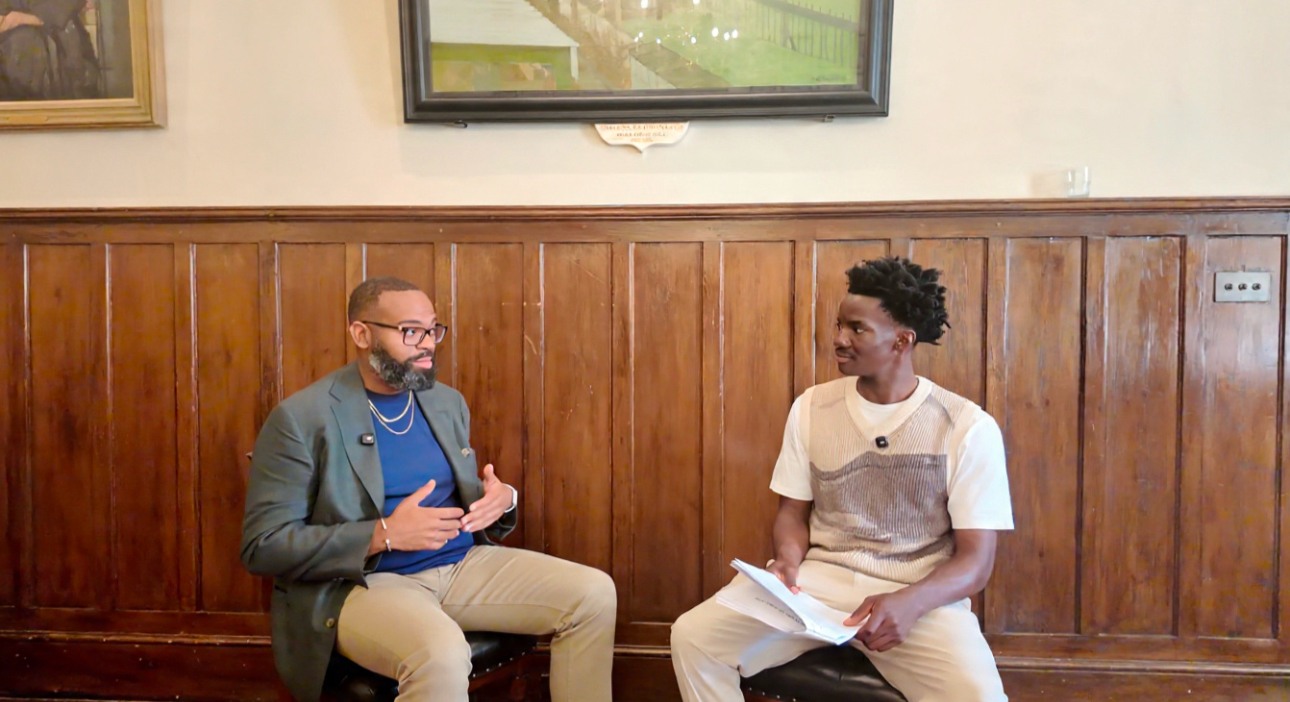
This distinction sits at the centre of this conversation with Taikein Cooper, Chief Executive Officer of Richmond Ed Fund. The organisation describes its work as connecting Richmond students to the resources, opportunities and support that can expand their economic mobility. In our discussion, Cooper returned repeatedly to a simple but consequential idea: schools cannot stop at telling students what is possible. They have to help make a next step reachable.
The conversation was recorded alongside a convening where Cooper and I co-facilitated a tabletop session on public schools as access-centred routes into apprenticeship degrees. This article is based on the separate interview. It focuses on Cooper's account and the questions it raises; it is not a comprehensive assessment of the US education system or of Richmond's programmes.
The distinction
The difference between awareness and access
Cooper explained the distinction through an everyday analogy:
“It's just like someone telling you that there's food in the world, and you actually having food that's accessible to you.”
Taikein Cooper
Awareness tells someone that an opportunity exists. Access asks whether that person can realistically reach it. The two are related, but they are not interchangeable. A school can publish information about apprenticeships, invite an employer to speak or list training routes on a website without ensuring that students understand the work, know how to enter it or have the support required to participate.
For Cooper, closing that gap requires more than a single programme or a school acting alone. He described the need for businesses, trade unions and higher education institutions to work together so that young people encounter opportunities through connected relationships rather than disconnected acts of outreach. The goal is not simply to increase the number of students who have heard of a pathway. It is to build the conditions in which they can explore it, assess whether it fits and take a supported next step.
He also argued that this work should begin early. In his view, exposure should not start only when a student is approaching graduation or preparing an application. Earlier contact can help build familiarity and curiosity long before a formal career decision is required.
Responsibility
What are schools graduating students into?
When asked what responsibility schools carry without enough infrastructure behind them, Cooper offered a striking estimate: he believes roughly 99 per cent of K–12 systems in the United States behave as though their responsibility ends at graduation. That figure is his estimate from the conversation, not an independently verified national statistic.
He contrasted that perceived stopping point with a question he says his district asks: “What are we graduating kids into?” It changes the measure of success. A diploma remains important, but it is not the whole transition. The question becomes whether a young person leaves school with a credible sense of what comes next, relationships that can help them navigate it and support that continues when the school timetable ends.
Cooper spoke about agency and social capital as part of this preparation. Students need more than a list of options: they need to see how an option might connect to their own interests and circumstances, and to believe that it is genuinely attainable. That belief cannot be created by messaging alone. It is shaped by who students meet, what they experience and whether the institutions around them follow through.
Status
A status problem, not only an information problem
Cooper also described a cultural barrier. In the US context he discussed, apprenticeships and skilled trades have often been treated as lower-status choices than a four-year college route. High-achieving students may be publicly celebrated for going to college, while young people choosing technical or work-based pathways receive less recognition.
During the interview, Cooper described a signing-day event that Richmond Ed Fund was planning for spring 2026. The idea was to borrow the public energy of a professional sports draft: bring employers and media into the room and celebrate students choosing apprenticeships or skilled-trade routes. The aim was to make those choices visible and valued, rather than treating them as a fallback.
Cooper was also clear that students who have not historically been labelled high achievers should not be excluded from the opportunity to be celebrated and supported. He connected that concern to people in his own family and community who had not received the same opportunities he had. His point was not that every student should follow the same route, but that the system should take seriously the possibility of success across different routes.
Barriers
Readiness requires removing barriers, not just raising expectations
The practical supports Cooper described make the difference between an opportunity being advertised and being usable. He spoke about counselling, transportation, starter tools and personal protective equipment, including boots and goggles where a trade requires them. These are not minor extras if a student cannot afford them or cannot get to the workplace.
He also emphasised that supporting a 16- or 17-year-old entering a workplace is different from supporting an experienced adult. Younger learners may need more guidance, structure and wraparound support as they learn what the work involves and how to navigate a professional environment.
This raises an important distinction for readiness work. A learner may be motivated and capable but still be unable to participate because transport, equipment or support is missing. In that situation, describing the problem as a lack of learner readiness would misdiagnose the barrier. The response needs to address the condition preventing participation, not simply ask the student to demonstrate more motivation.
Early exposure
How early should employers become involved?
Cooper argued that employers can begin contributing much earlier than the point at which students are ready to apply for jobs. He suggested age-appropriate career days, field trips and guest speakers from the first or second grade, with more structured work-based learning as students move through secondary school.
He connected this idea to a memory from his own childhood: a “transportation day” that allowed children to explore vehicles ranging from planes to fire engines. That experience helped spark his interest in transportation. The example illustrates what early exposure can do without turning it into an expectation that a child should make a fixed career choice at a young age.
The purpose of early exposure, as Cooper described it, is to make occupations more familiar and imaginable. It can give students a starting point for later questions:
- What does this work involve?
- What skills does it require?
- What would the training route look like?
- Who could help me explore it?
Employers, schools and community organisations can each contribute, but the experience becomes more useful when those contributions connect.
Progression
The missing middle: what happens after someone starts?
A further part of the interview turned to what happens between entering a programme and completing it. I raised the possibility of using earlier indicators of disengagement to identify when a learner might be at risk of dropping out, so that support could be offered before the learner disappears from the programme.
Cooper's response moved to a related but distinct issue: the durable, essential or life skills that help someone function and progress once they are inside an opportunity. He described examples such as showing up on time, communicating professionally and developing confidence in workplace interactions. He also discussed Richmond Ed Fund's work exploring a “life readiness course” intended to address this part of the transition.
The distinction matters. Early warning systems may help an institution notice that a learner is becoming disengaged. They do not, by themselves, build the capabilities or improve the conditions that would help the learner stay and succeed. Equally, a life-readiness course may develop useful skills, but it does not automatically resolve barriers such as poor supervision, inaccessible transport or a mismatch between the role and the learner's expectations.
Cooper described this as a “missing middle”: the space between formal education and the everyday expectations of work that can be assumed rather than explicitly taught or supported. His contribution to the conversation was to draw attention to this layer of preparation, not to claim that one course or one measure can solve every transition problem.
Visibility
Social capital: can relationships become part of the pathway?
At the end of the interview, I asked the same question posed to every contributor in the series: if one thing about workforce readiness could be made more visible before someone enters work, what would it be?
Cooper turned to social capital. He asked how it could be made tangible, explaining that in his context he had not seen a meaningful way to quantify it or build it systematically. The familiar phrase “it's not what you know, it's who you know” points to the importance of relationships, but it can also disguise how unevenly those relationships are distributed.
He used the connection formed through the convening and this research conversation as an example of social capital in action. He also responded positively to the idea of peer-to-peer mentorship: connecting a young person with someone closer to their own recent experience, who may be able to explain a route in terms the learner recognises.
This raises a question for readiness research. Relationships can provide information, encouragement, introductions and practical help. But what would it mean to make those resources more available without reducing social capital to a crude score or treating a high number of contacts as proof of meaningful support? The quality, relevance and accessibility of relationships may matter more than their count.
Implications
What this raises for Apprentis
Cooper's perspective brings the access question further upstream. If a pathway is to work, it is not enough for an opportunity to exist or for a student to receive a signal about it. The student needs a way to encounter the opportunity, understand it, reach it and receive support as they progress.
It also reinforces the need to distinguish between different kinds of barriers. A lack of awareness may call for better information and exposure. A lack of access may require transport, equipment, relationships or a more direct route into an employer. A difficulty sustaining participation may call for stronger supervision, practical support or development of durable skills. These are not interchangeable interventions.
For Apprentis, this is a useful prompt for examining how readiness information should be interpreted. A signal about a learner only becomes useful when it is understood in context:
- What condition does it reveal?
- Who is in a position to respond?
- What action is appropriate?
- What happens afterwards?
A school may see one part of the picture; an employer, training provider or community partner may hold another. The challenge is to connect those perspectives without assuming that the learner alone is responsible for making the system work.
This conversation does not validate a particular measurement model, prove that social capital can be reliably scored or establish that early exposure leads to specific employment outcomes. Those are questions for further research. What it does offer is a practitioner's account of how awareness, access, material support, early exposure and relationships intersect in the work of building more reachable pathways.
What remains open
What remains open
Several questions remain unresolved:
- How should schools and employers share responsibility for supporting a young person beyond graduation?
- Which practical barriers most often prevent students from taking up opportunities, and how can institutions identify them early?
- What forms of exposure build useful understanding rather than simply generating interest?
- How can durable skills be developed without implying that young people must compensate for weaknesses in workplace design?
- Can social capital be strengthened and made more equitable without reducing it to a simplistic metric?
These questions cannot be answered by one interview. They need to be considered alongside the other perspectives in The Systems Behind the Pathway, and tested against evidence beyond the conversations themselves. The season's synthesis will bring those perspectives together, identify where they converge and disagree, and make clear what the evidence supports and what remains open.
Contributor: Taikein Cooper, Chief Executive Officer, Richmond Ed Fund.
About this article
This article reflects one conversation within Apprentis's ongoing Systems Behind the Pathway research series. It presents Taikein Cooper's professional perspective alongside questions and analysis developed by Apprentis. It is not a comprehensive evaluation of Richmond Ed Fund, Richmond Public Schools or the US apprenticeship system, and it does not represent the series' final conclusions.